
Low home loan rates by banks could put large players in an advantageous position over smaller non-bank players, believe analysts.

The Colgate-Palmolive (India) stock gained 2.3 per cent in trade on Friday, and ended at Rs 2,079 per share. This was on the back of a robust operating performance in the July-September quarter of 2023-24 (Q2FY24) and expectations of gradual sales recovery going ahead. While the stock is up 44 per cent from its lows in January this year, further gains will depend on its ability to sustain higher growth rates.

Investors must adopt a balanced approach, incorporating both styles in their portfolios.

Global trends, macroeconomic data, and the outcome of the US Fed policy meeting are the major factors that will drive the movement in the domestic equity markets this week, analysts said. "In the upcoming data-centric week, the focus will be on crucial releases, including inflation data from India and the US. "Indian inflation is expected to rise, while US inflation will remain steady.

'It was specifically mentioned in the Gadgil Committee report that this particular area where the colossal landside happened now should be in the Environmentally Sensitive Area under Zone 1.' 'Zone 1 is the most important and ecologically sensitive area, and that it has to be protected entirely.' 'At least 90% of the Wayanad disaster is man-made.'

While tenants can't escape the impact of rising rentals entirely, they can adopt a few strategies to reduce the impact.

'A credit line on UPI is going to make banks think about credit fundamentally as they digitise the credit process entirely.'

The GoM was apprised that as of now, the death rate is around 3.1 per cent while the recovery rate is more than 20 per cent, which is comparatively better than most of the countries and may be taken as a positive effect of the lockdown in the country, along with the cluster management and containment strategy.

Even as Srini Pallia, a Wipro veteran, is set to take charge as the chief executive officer (CEO) of the company, analysts expect the stock's underperformance to continue in the near-future. This, they believe, will be on the back of likely loss of market share, and difficult business environment. "We expect Wipro to underperform peers on growth once again in FY25 as channel checks and media reports suggest Wipro is losing share with select clients across multiple verticals.

The index is currently trading at 149 per cent of its historical P/B valuation, surpassing its previous peak of 125 per cent made in 2020-21.

Market participants attribute the stability to the Reserve Bank of India's timely intervention in the foreign exchange market, both in terms of selling and buying dollars.
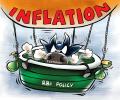
Inflation in food articles basket was 6.99 per cent In May, 2019, down from 7.37 per cent in April. However, onion prices spiked in May with inflation at 15.89 per cent, as against (-) 3.43 per cent in April.

Rising penetration of trade generic medicines is eating into the value growth of the domestic pharmaceutical market, showed a recent analysis. According to a Kotak Institutional Equities analysis, 70-110 basis points (bps) annual dent is expected from trade generics and Jan Aushadhi on Indian Pharma Market (IPM) growth at least until FY27-28 (see chart). Trade generic medicines are those that are not pushed into the market through doctor promotions.

Among the Sensex firms, Larsen & Toubro, UltraTech Cement, JSW Steel, Titan, Bajaj Finance, Wipro, Tech Mahindra and Nestle were the major laggards. Maruti, Power Grid, Axis Bank, State Bank of India, NTPC, HDFC Bank, ITC and IndusInd Bank were the gainers.

'The first duty of the government is to learn lessons from a bad experience and course correct. It's a pity that the government is making policy without looking at evidence and differentiating between immediate and urgent.'

The stock of fast-moving consumer goods major Tata Consumer Products has been reaching new all-time highs on better-than-expected results for the July-September quarter (second quarter, or Q2), strong growth in the food business, and margin gains in the beverage/international business. Most brokerages are positive on the stock, given growth prospects, and believe that rich valuations are justified. The near-term trigger has been the robust operational performance in Q2.

The migration of domestically developed intellectual property to foreign corporations within India reflects an anomaly in the demand pattern of the country's job market, points out Kanika Datta.

India's COVID-19 tally had crossed the 20-lakh mark on August 7.

Govt to strongly pitch for better rating, to argue India has successfully weathered its problems and govt capacity on growth remains high.

Equity benchmark Nifty scaled the psychological milestone of 21,000 in afternoon trade on Friday, and the Sensex touched its all-time intraday high of 69,888.33 after the central bank's decision to keep policy rates unchanged in line with market expectations. The 50-share benchmark index opened on a bullish note, after taking a breather on Thursday, and rose to 21,006.10. As many as 25 stocks were trading in the green, and 24 stocks defied the broader market and were trading in the negative territory.

The stock of Godrej Consumer Products Limited (GCPL) fell about 3.7 per cent in trade after its Q3FY24 earnings disappointed brokerages and led to downgrades. Further, the stock, after a 15 per cent run-up over the past month prior to Monday's correction, had already factored in the upside from the business front. Its peer in the consumer space, Marico, too, saw a 4 per cent drop in its stock price.

Benchmark equity indices climbed nearly 1 per cent on Wednesday on buying in HDFC Bank and Reliance Industries. Investors are eyeing the two important events lined up ahead -- the interim budget and the US Fed interest rate decision -- to derive further cues from. Recovering all the early lost ground, the 30-share BSE Sensex jumped 612.21 points or 0.86 per cent to settle at 71,752.11.

This is a good opportunity for long-term investors to pick quality small and midcap stocks at reasonable valuations.

rediffGURU Ramalingam Kalirajan answers your personal finance queries.

Even as the near-term outlook for the quick service restaurant (QSR) industry remains muted, brokerages are positive about the prospects of Sapphire Foods India. Their preference for the QSR chain comes on the back of the steady performance of Kentucky Fried Chicken (KFC), superior execution and reasonable valuations. The Sapphire Foods stock is up 11 per cent since the start of November.

The general elections in April/May 2024 are expected to add volatility to the Indian markets, keeping investors on their toes.

At least five people have been arrested by the city police which busted the scam earlier this month.

Even as the slowdown in the information technology (IT) services sector deepens, banking, financial services and insurance (BFSI), as well as oil and gas companies, emerge as the primary drivers of corporate earnings in the country. The IT services sector's share in corporate earnings declined to a five-year low of 17.4 per cent in the second quarter (Q2) of 2023-24 (FY24), whereas banks and finance companies accounted for 46.5 per cent, and oil and gas firms contributed 16.8 per cent. At their peak, IT services firms like Tata Consultancy Services (TCS), Infosys, HCLTech, and Wipro represented just over a third of the combined net profit of all listed companies in the Business Standard sample.

Among the Sensex firms, Asian Paints, Tata Steel, HCL Technologies, Nestle, Maruti, JSW Steel, NTPC and Larsen & Toubro were the major laggards. Sun Pharma, Bajaj Finserv, Reliance Industries, State Bank of India and Bharti Airtel were the gainers.

Among the Sensex firms, State Bank of India, ITC, Nestle, Asian Paints, Tech Mahindra, Mahindra & Mahindra, Tata Consultancy Services and Hindustan Unilever were the major laggards. In contrast, HCL Technologies, Power Grid, Sun Pharma, NTPC, Bajaj Finance and Titan were the gainers.

Among the Sensex firms, Infosys, Tech Mahindra, HCL Technologies, Tata Consultancy Services, Wipro and JSW Steel were the major gainers during the morning deals. Nestle, Bharti Airtel, Axis Bank ITC were among the laggards.

Among the Sensex firms, JSW Steel, Tata Steel, Tech Mahindra, Infosys, Wipro, Tata Consultancy Services, Nestle, HCL Technologies, HDFC Bank and Maruti were the major laggards. IndusInd Bank, ITC, Bharti Airtel and State Bank of India were among the winners.

'This can eventually start the end of the current market frenzy, which has lasted for a full year.'

The number of ultra-high net worth individuals (UHNWIs) in India is expected to rise 58.4 per cent in the next five years from 12,069 in 2022 to 19,119 in 2027, a report by property consultancy Knight Frank said on Wednesday. In its "The Wealth Report 2023", Knight Frank said that the number of Indian UHNWIs, with a net worth of $30 million or above, fell 7.5 per cent in 2022 due to economic slowdown, rate hikes, appreciation of the US dollar and geopolitical uncertainties. Globally, the number of UHNWIs fell 3.8 per cent in 2022 compared to 2021.

As the triangular political contest in Telangana intensifies, many believe that for the regional major BRS, it is a battle for survival after being routed in the assembly polls held late last year. What is haunting the party this time is the scams, the 10-year anti-incumbency factor, and family dominance in the party.

Mukesh Ambani, the patriarch of Reliance Industries (RIL), and Gautam Adani, the chairman of Adani Group of companies, have secured the top positions on the Fortune India Rich List, created in partnership with Waterfield Advisors, with respective wealth of $99.7 billion and $63.71 billion. With a wealth of $34.6 billion, the Mistry family of Shapoorji Pallonji Group holds the third position on the list, while the Poonawalla family, owners of vaccine maker Serum Institute, with a wealth of $32.9 billion, stands fourth. Stockbroker and founder of D-Mart-branded grocery stores, Radhakishan Damani, claims the fifth spot on the India Rich List with a wealth of $23.4 billion

Build a portfolio diversified across market caps, investment styles, and geographies.

Gold is currently trading at Rs 25,200 for 10 grams.

'We aim at establishing India as an early talent hub on a global scale and are actively recruiting professionals in areas like cybersecurity, machine learning, data science, and other relevant fields.'
With prices of pulses playing a big role in the rising inflation rates in India, the government may allocate more funds for research in pulses development.
 © 2026 Rediff.com - Advertise with us - Disclaimer - Privacy Policy - Sitemap - Feedback - About us - Terms of use - Grievances